The Arc's Strategic Playbook

The Arc’s Strategic Playbook

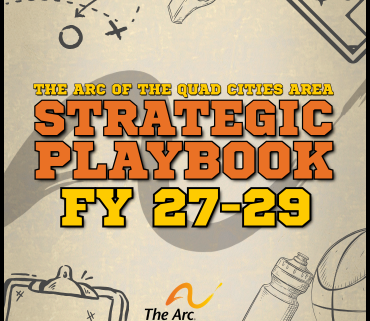
Introducing The Arc’s Strategic Playbook

At The Arc of the Quad Cities Area, we believe that meaningful progress requires more than a roadmap; it requires the flexibility to adapt, respond, and grow alongside the community we serve.

That’s why we’ve reimagined the traditional strategic plan and developed something more dynamic: our Strategic Playbook.

Unlike a conventional plan that can feel fixed and rigid, a playbook is designed for real-world situations. In sports, coaches and players adjust their strategy based on what’s happening on the field. The same principle applies to our organization. A playbook helps us stay focused on our mission while remaining agile enough to respond to new opportunities, challenges, and community needs.

Our Strategic Playbook outlines the goals, priorities, and guiding principles that will help shape The Arc’s future. It reflects our commitment to inclusion, innovation, and continuous improvement while providing a practical framework for decision-making and action.

Most importantly, this playbook recognizes that success isn’t achieved through a single initiative or milestone. Success is built through collaboration, consistency, and a shared commitment to empowering individuals with intellectual and developmental disabilities to live their best lives.

We invite you to explore the full Strategic Playbook and learn more about the vision, goals, and strategies guiding The Arc into the future.

👉 View the full Strategic Playbook on our Publications page:
https://arcqca.org/wp-content/uploads/2026/06/Strategic-Playbook-EditedComp.pdf

Join us as we turn strategy into action and continue Building Beyond Barriers together.

Why Community Living Matters

Why Community Living Matters

The Fragile Infrastructure of Community Living: Why HCBS Matters

The debate over disability policy and funding often feels abstract, but for those of us living in the community, it is deeply personal. My daily life depends on Home and Community-Based Services (HCBS) funding. Without the support of a Direct Support Professional (DSP), I cannot get up and out of bed for my work or even manage breakfast, and without a DSP, I cannot go into the community at all.

The fragility of this system is becoming increasingly clear, as recent federal actions—such as the U.S. Department of Justice’s June 2026 opinion questioning the Olmstead Integration Mandate—threaten to destabilize the very support network that makes my life possible. While this is an opinion and not a law, it creates an environment that makes me feel like my basic rights are seen as not important.

The impact of this opinion and policy shift has the potential to be direct and severe.  Even though the DOJ acknowledges that this opinion is “out of step” with precedent, the act of questioning the integration mandate weakens the chances for federal enforcement.  This gives states what feels like a “Green Light” for funding cuts to what are currently elective services.

However, in my life, the supports of HCBS are essential.  Without this support, my life would be that of being stuck in an institution or nursing home without the ability to continue to pursue my work, my dreams, and my desires.

Without federal protection, we make it harder for states and local providers to do their jobs, directly endangering the independence of people with disabilities. We need federal policy and opinions that strengthen, not undermine, the community-based support systems that allow us to live with dignity.

—Bob Peterson, Self-Advocate Advisor for Policy and Engagement